A Stationery Lover's Guide to Florence: Notebooks, Paper and Pen Shops
October 29, 2026 - Inspiration

October 28, 2026 - Inspiration
October 23, 2026 - Notebooks
October 19, 2026 - Writing Tools
Open a journal to a page written six months ago and you can usually tell which tool did the work before you read a word. Gel ink sits on the surface, even and glossy, with the faint swell of a line that dried in place. Mechanical pencil looks pressed into the sheet instead, a little grey, carrying the small variations of a hand that was thinking. Both are good. Neither is the correct everyday writer. The choice comes down to four things that show up on every page you keep: smudging, permanence, pressure, and how the tool behaves on the paper you actually like.
Journaling habits vary more than journal recommendations admit. Some people write in one clean pass, fast, and never look back. Others draft a thought, cross out half of it, rephrase, and sketch a small diagram in the margin to explain the rest. A gel pen suits the first style; a mechanical pencil suits the second.
Pencil invites revision, and that can cut both ways. If you tend to soften every sharp sentence before you finish it, an erasable tool makes it easy to sand the page down to something polite and vague. A pen commits you. There is no undo, so the honest version stays. Know which of those two pressures helps you and which one makes you self-conscious, because that matters more than line width or lead grade.
Also think about where the book gets written. In bed, on a train, balanced on a knee, with the spine propped open on a kitchen counter while something simmers. Both tools travel fine. Gel dries on its own; pencil needs nothing but a spare lead. Neither asks much of you, which is why the decision really belongs to the page.
Gel smudging is a drying problem. The ink is water-based in most refills, so it sets quickly on absorbent paper and more slowly on smooth, coated stock. If your hand drags across a fresh line, you get a grey-blue smear and a faintly doubled letterform. Smooth paper makes the line look wonderful and dries slower; that trade-off catches people out.
Ways to work around it: write the right-hand page first, then the left, so your hand never crosses fresh ink. Keep a sheet of blotting paper or a folded card under your wrist. Choose a quick-drying refill rather than the juiciest one on the shelf. And give the page a few seconds before you close the book, especially if the notebook lives in a bag.
Pencil smudging is a transfer problem. Graphite never dries because it was never wet. Soft leads, the 2B and 4B that feel so good to write with, shed the most and smear under the heel of your hand. They also mirror onto the facing page, so a spread you wrote last month can slowly collect a ghost of itself. For everyday journaling, HB or B is usually the practical middle: dark enough to read comfortably, hard enough to stay put. A sheet of glassine or thin card between pages solves most of the rest.
Over-writers push across the page and cross their own lines; under-writers hook beneath them. Gel gives the over-writer more trouble, so quick-dry refills and a blotting sheet earn their place. With pencil, the risk is a silvered edge along the side of your hand rather than a ruined word, which is easier to live with. A plain sheet of paper under the palm fixes it.
For a journaler, permanence means two things: will this still be readable in ten years, and can it be changed by accident?
Dried gel ink is reasonably durable and sits well on the page, but it is not invincible. A spilled glass of water can lift or feather a line, particularly with dye-based inks; waterproof and pigment formulations handle it better, and they are worth the small premium if you journal near coffee cups or carry the book in the rain. Graphite, by contrast, does not run. A soaked page may wrinkle, but the writing stays. It also resists the slow fading that light causes in some inks.
The catch is obvious: pencil can be erased. That is either the point or the problem. A pencil journal is permanent only until someone decides otherwise, and the someone is usually you, at eleven at night, rereading an entry you'd rather soften. Gel writes a record you cannot quietly amend. If you keep journals to remember accurately rather than to feel good about the draft, that commitment is the whole argument.
Gel pens ask almost nothing of you. Ink flows on its own, so the pen does the work and your grip can stay loose. Long sessions, small handwriting, rapid note-taking: gel is comfortable. The cost is that a very light touch can produce a stingy, skipping line, and some refills blob slightly on the first stroke after a pause.
Pencil needs contact. You press just enough for the lead to lay down, and how much you press changes the line. Hard leads like 2H or 4H give pale lines and require more force, which is tiring and leaves grooves. Soft leads give dark, expressive lines with almost no effort but wear down fast and smudge. Lead diameter matters as much as grade: 0.5 mm snaps under a heavy hand, 0.7 mm is a decent everyday compromise, and 0.9 mm suits larger handwriting and writers who lean in. If your hand cramps after two pages, look at the barrel before you blame the lead. A wider grip section and a relaxed hold do more than any change of grade.
Gel rewards smooth, well-sized paper. The line stays crisp, edges stay sharp, and nothing feathers into the fibres. That same smoothness keeps the ink wet longer, so dry time stretches out. On absorbent paper the opposite happens: lines spread slightly, letters thicken, and the reverse of the page shows a shadow of what you wrote.
Pencil rewards texture. Paper with a little tooth grabs graphite and gives a darker, more even line with less effort. On very smooth stock a hard lead skates and looks washed out, while a soft lead sits on top and smears at the first touch. Pencil also indents. On thin paper, a firm hand produces raised ghosting on the back of the sheet, which is why a card backing sheet is the cheapest upgrade in the whole setup.
Before you commit to a tool, run a five-minute test on the actual notebook you plan to fill:
Give each tool a week in the same notebook, writing at your usual length and time of day, then reread both sets of pages. You will notice something quickly: one of them will have made the writing easier to start.
If you want a rule rather than a test, split the work. Pencil handles the parts of a journal you expect to revise: habit trackers, monthly logs, planning spreads, pages where you sketch out a decision. Gel handles the dated entries, the reflections you want fixed in place, the letters to yourself you would rather not edit later. Keeping one of each in the pen loop costs almost nothing and removes the decision entirely.
And if you only want one daily writer, let the paper vote. The notebook you love writing in will make one of these tools feel obvious within an hour. Trust that over any comparison chart, including this one. The best everyday writer is not the most permanent or the smoothest. It is the one that gets you to open the book on a Tuesday night when you are tired and have nothing much to report.
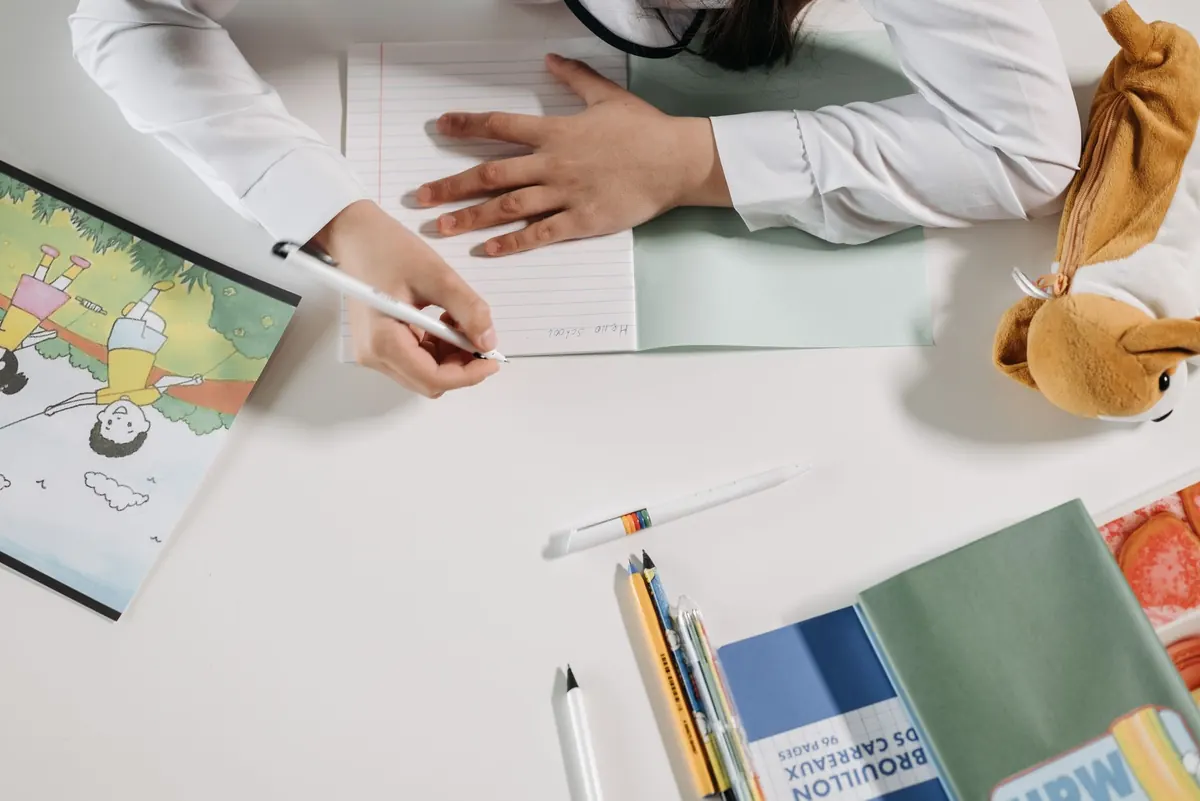
Photo: Pavel Danilyuk / Pexels
A practical browsing guide to Florence’s stationery shops, from historic cartolerie and marbled-paper workshops to...
Thirty autumn journaling prompts to help you record falling leaves, small rituals, family memories, and the quiet...
October 28, 2026 - Inspiration
October 23, 2026 - Notebooks
Copyright © 2026 Quaderno Nero. All Right Reserved.