A Stationery Lover's Guide to Florence: Notebooks, Paper and Pen Shops
October 29, 2026 - Inspiration

October 28, 2026 - Inspiration

October 23, 2026 - Notebooks

October 19, 2026 - Writing Tools
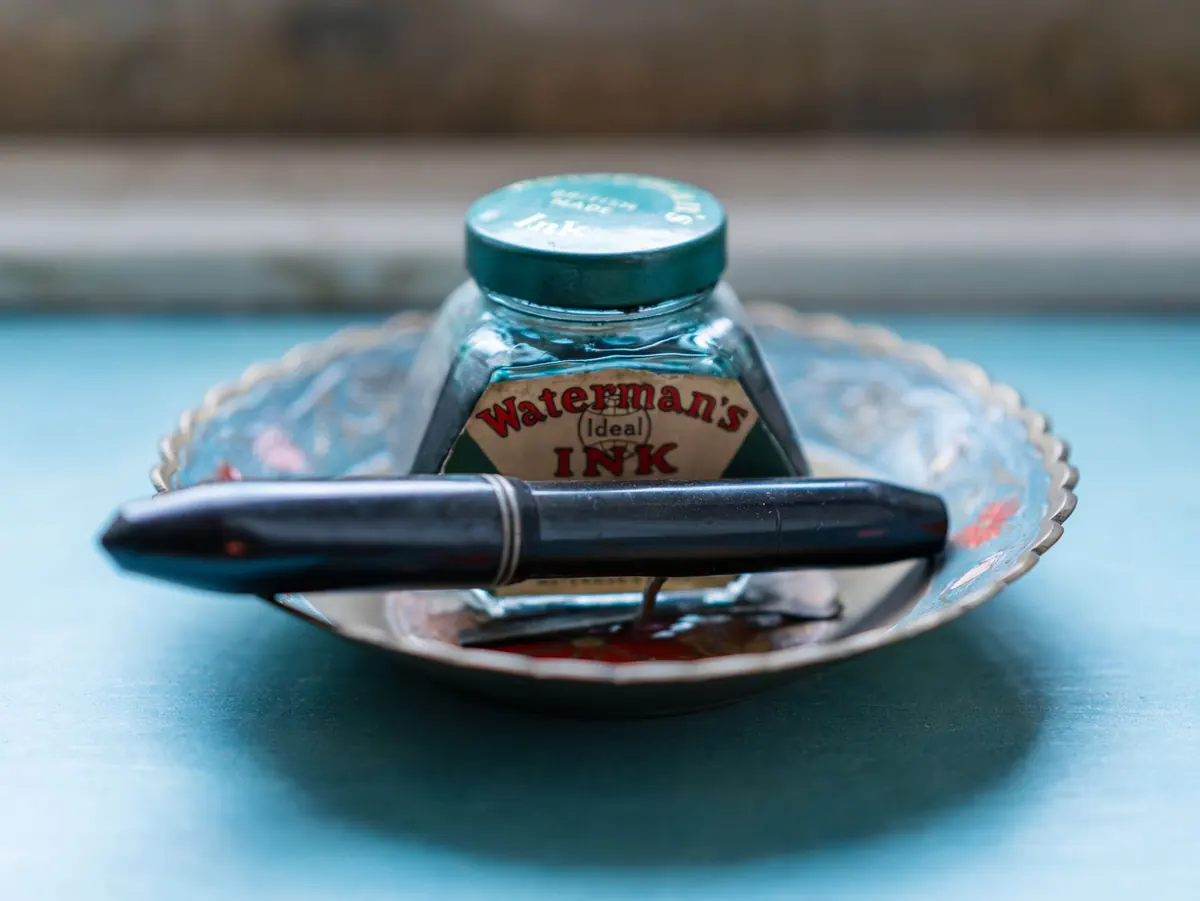
Fountain pen ink is where many journalers discover that the pen is only half the decision. The same nib can feel silky in one bottle and scratchy in another; a colour that looks wonderful in a swatch can sit wet on the page for twenty seconds and then smear across the facing page when you close the book. It is a small choice with daily consequences.
The good news is that journaling is a forgiving use case. You are not signing contracts or writing on carbon-copy forms. You are writing in a book you chose, at a pace you set, mostly at home. A little knowledge about what is in the bottle — and what is in the paper — is enough to pick a first ink you will still be happy with a year from now.
Almost every bottle sold for fountain pens falls into one of three groups. They behave differently, and they ask different things of you.
Colour dissolved in water. These offer the widest colour range, usually feel smooth in the nib, and clean out easily with plain water. They are the safest place to begin. The trade-off is that many remain partly water-soluble after drying, so a spilled glass can lift colour off the page even after the ink has set.
Tiny solid particles suspended in a liquid carrier. They sit on the surface of the paper rather than soaking in, which makes them reliably water-resistant and resistant to fading. The cost is maintenance. Shake the bottle before filling, clean the pen more often than you would with a dye ink, and never leave one sitting unused in a pen for weeks, because the particles settle into the feed and are stubborn to shift.
The traditional blue-blacks, which go down blue and darken to near-black as they oxidise on the page. They are water-resistant and behave beautifully on cheap paper. Modern formulations are far gentler than the historical ones, but they are still acidic: rinse the pen every few fills, and do not leave one loaded and untouched for months.
There is a fourth category to keep away from fountain pens entirely: india ink, calligraphy ink, acrylic ink, anything containing shellac or particles and not labelled for fountain pen use. Those belong in dip pens and brushes. In a fountain pen they dry solid inside the feed and can wreck it.
Ink descriptions are full of adjectives. These are the properties that will affect your journaling day to day.
On ordinary absorbent paper, most dye inks are touch-dry within a few seconds. On a smooth, coated journal paper with a broad, wet nib, the same ink can take half a minute or more. Nothing has gone wrong; the coating that makes the page feel lovely also slows absorption.
You have four levers: the nib, the ink, the paper, and your habits. A fine nib lays down less liquid than a broad one. A less saturated ink dries faster. Rougher paper drinks ink. And small habits cover the rest:
If you can see the faint shape of your writing through the page, that is ghosting, and it is a property of thin paper, not a fault in your ink. Most journalers accept it. Bleed-through is different: ink actually appears on the reverse in visible dots or lines. It usually means the paper is too absorbent or too thin for a wet nib and a saturated ink.
Feathering is the fuzzy, slightly hairy edge a line gets on poor paper, where the ink wicks along the fibres. Before you blame the bottle, test. Write a few lines on the last page of a new journal with your pen as it is. If it feathers there, a finer nib or a drier ink will help more than a new pen will.
A journal is an archive, even if only for you. If you write on trains, in cafés, or with children nearby, water resistance earns its keep. Pigment inks and iron gall inks are the practical choices; some brands sell dedicated document inks formulated for permanence.
Weigh that against how you actually use pens. If a pen sits in a bag for a month between entries, a well-behaved dye ink is the kinder option and the page will still outlast the notebook. If you write daily and rinse your pen when you refill, a pigment black is a reasonable everyday companion.
Buy one ink you can live with, use it until the bottle is half empty, and take notes on the back page: which paper it liked, whether it smeared, how it looked after a month. Then try one thing deliberately different — a water-resistant pigment, an iron gall blue-black, a drier ink for cheap paper. That is how an ink shelf gets built without waste.
Two habits will keep everything running. Rinse the pen with clean water between fills, and never mix two inks in a converter to see what happens. If the pen starts skipping or writing dry, flush it before you blame the ink. Then get back to the writing, which is the whole point.
Photo: Ar kay / Pexels

A practical browsing guide to Florence’s stationery shops, from historic cartolerie and marbled-paper workshops to...
Thirty autumn journaling prompts to help you record falling leaves, small rituals, family memories, and the quiet...
October 28, 2026 - Inspiration
October 23, 2026 - Notebooks
Copyright © 2026 Quaderno Nero. All Right Reserved.